When Melbourne throws a 40°C scorcher one day and a freezing 8°C morning the next, your air conditioner isn’t a luxury — it’s a lifeline. And if you’re in the market for a new split system, chances are you’ve come across two names more than any other: Daikin and Rinnai.
Both are solid, reputable brands. Both are widely installed across Victoria. But they’re not the same — and choosing the wrong one for your home, your climate, and your budget can cost you thousands over time.
At Eco Spread, we’ve been installing air conditioning systems across Melbourne and regional Victoria for years — from the inner suburbs of Melbourne to the cooler highlands of Ballarat and Bendigo, from the coastal streets of Geelong to the growing communities of Moe, Somerville, and everywhere in between. We’ve installed hundreds of both brands, and we know exactly where each one shines.
In this guide, we’ll break down everything you need to know — so you can make a confident, informed decision. Then let our expert team handle the rest.
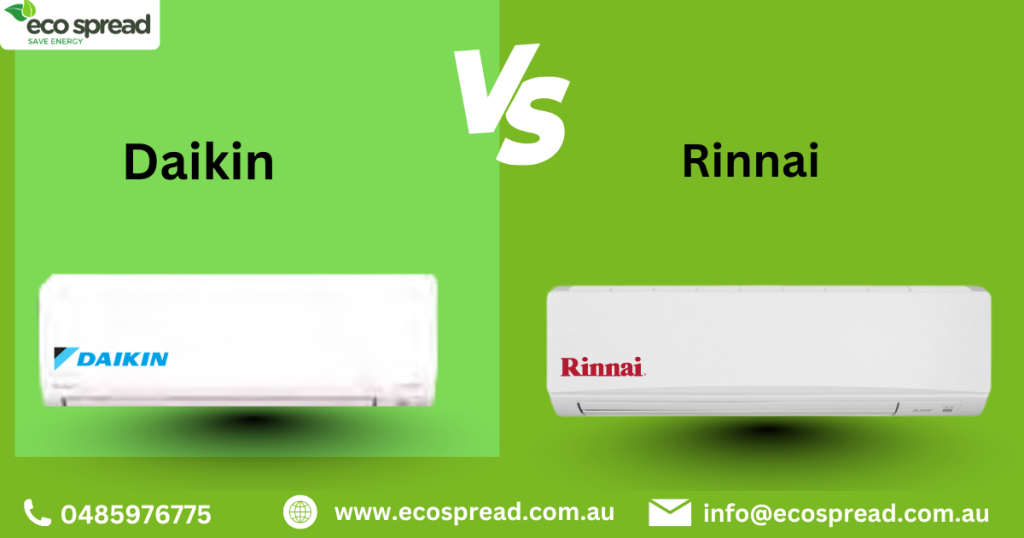
Who Is Daikin?
Founded in Japan in 1924, Daikin Industries is the world’s largest air conditioning manufacturer, operating in over 150 countries. They don’t make refrigerators or washing machines — air conditioning is their entire business. That singular focus shows in the quality, efficiency, and innovation of their products.
In Australia, Daikin has become the go-to premium brand for homeowners and builders who want the best. Their inverter technology is widely regarded as class-leading, their energy star ratings are among the highest available, and their product range covers everything from compact single-room split systems to large-scale commercial ducted installations.
Key reasons Melbourne homeowners love Daikin:
- Industry-leading inverter compressors for precise, efficient operation
- Energy star ratings of 5 and 6 stars on many models
- Ultra-quiet indoor units — some as low as 19dB, quieter than a whisper
- Advanced multi-layer filtration including anti-allergen and deodorising filters
- Full Wi-Fi connectivity and smart control via the Daikin app
- Cold-climate heating technology that operates efficiently down to -15°C ambient
- Extensive product range — single room splits, multi-head, ducted, and commercial
- 5-year parts and labour warranty on most models when installed by registered installers
Who Is Rinnai?
Rinnai is a name most Australian households know well — primarily through their hot water systems and gas appliances. Their air conditioning range may be less well-known, but it’s genuinely solid and deserves serious consideration, particularly for buyers who want dependable performance without paying a premium price.
Rinnai air conditioners are built to Australian conditions, backed by a strong local service network, and offer good energy efficiency across their split system range. For many households — particularly in regional Victoria — Rinnai delivers exactly what’s needed without unnecessary complexity.
Key reasons Victorian homeowners choose Rinnai:
- Reliable, durable build quality suited to Australian climates
- Competitive pricing — typically more accessible than Daikin
- Good energy efficiency with solid inverter performance
- Simple, straightforward controls — easy to operate for all ages
- Quiet indoor operation with good airflow distribution
- Strong Australian service and parts network
- 5-year product warranty on most models
Daikin vs Rinnai Air Conditioners: The Head-to-Head Breakdown
Energy Efficiency
This is where Daikin pulls ahead most clearly. Their inverter compressors consistently achieve higher COP (Coefficient of Performance) figures, meaning they produce more heating or cooling output per unit of electricity consumed. In Victoria, where electricity prices are among the highest in the country, this matters every single month on your power bill.
Daikin’s top-tier models can be up to 40% more energy efficient than older non-inverter systems, and their 5 and 6-star rated units deliver outstanding running cost savings. Rinnai’s systems are genuinely efficient — carrying respectable star ratings — but in direct comparisons, Daikin typically edges ahead on efficiency metrics.
Verdict: Daikin wins on energy efficiency.
Heating Performance in Cold Climates
If you’re in Ballarat, Bendigo, Melbourne’s outer east, or the Dandenong Ranges, this matters enormously. These areas regularly see overnight temperatures below zero in winter, and some air conditioners simply can’t keep up.
Daikin’s cold-climate technology is purpose-built for exactly these conditions. Many Daikin models maintain full rated heating output down to -15°C ambient temperature — meaning they don’t struggle or cut out on the coldest nights. This is a genuine, measurable advantage for cold-climate Victorian households.
Rinnai systems perform well in moderate cold, and are perfectly suitable for Melbourne’s general climate. But for the coldest areas of Victoria, Daikin’s cold-climate credentials are hard to match.
Verdict: Daikin wins in cold climates. Rinnai is fine for Melbourne’s general climate.
Pricing and Value
Daikin systems typically sit in the mid-to-premium price range. A quality Daikin split system for a standard bedroom or living area generally starts from around $900–$1,200 supply-only, with larger and more feature-rich models going higher. Premium series like the FTXZ (Ururu Sarara) sit at the top of the market.
Rinnai systems are generally more affordable, often coming in 10–20% below comparable Daikin models. For budget-conscious buyers, for rental properties, or for secondary rooms where peak performance isn’t critical, Rinnai offers genuine value without cutting corners on reliability.
Verdict: Rinnai wins on upfront affordability. Daikin’s higher efficiency can offset the price difference over time.
Smart Features and Connectivity
Daikin is ahead of the curve when it comes to technology. Most current Daikin models include built-in Wi-Fi, full control via the Daikin smartphone app, and compatibility with voice assistants including Google Home and Amazon Alexa. You can control your system from anywhere in the world, set schedules, monitor energy use, and receive filter maintenance reminders.
Rinnai offers smart features on select models, but their range is not as comprehensively connected as Daikin’s. For tech-savvy homeowners who want their AC integrated into a smart home ecosystem, Daikin is the stronger choice.
Verdict: Daikin wins on smart features.
Build Quality and Reliability
Both brands are reliable — this isn’t a situation where one is good and one is not. Daikin’s engineering heritage and global scale means they can invest heavily in R&D and quality control. Their build quality is excellent, and their systems are designed to last 15+ years with proper maintenance.
Rinnai’s systems are robustly built and have a track record of solid, trouble-free performance in Australian conditions. Their relatively focused product range means they can maintain tight quality standards across their lineup.
Verdict: Both brands are excellent. Daikin has a slight edge in engineering sophistication.
Warranty
Both Daikin and Rinnai offer 5-year warranties when installed by a registered installer. Daikin typically covers both parts and labour for the full 5 years on most models. Rinnai’s warranty terms can vary by model — some models offer 5 years on parts with shorter labour warranty periods.
This is why choosing a registered, authorised installer like Eco Spread matters — it’s the only way to ensure your full manufacturer warranty is valid from day one.
Verdict: Broadly comparable — always check the specific warranty terms for the model you’re purchasing.
Which Brand Is Right for Your Part of Victoria?
One of the things that sets Eco Spread apart is our deep, on-the-ground knowledge of Victoria’s incredibly varied climate. The right system for a bayside Melbourne home is not necessarily the right system for a house in Ballarat or a business in the Latrobe Valley. Here’s our regional breakdown:
Melbourne Metro and Inner Suburbs
Melbourne’s urban climate brings extreme summer heat — regularly 38–42°C during heatwave events — and cold winters that regularly drop below 5°C overnight. You need a powerful, efficient reverse-cycle system that handles both extremes without breaking the bank on running costs.
Our recommendation for Melbourne: Daikin split systems are the premium choice — the FTXM series in particular offers outstanding efficiency, quiet operation, and reliability across Melbourne’s climate. For value-conscious buyers, Rinnai’s split systems are a solid, dependable alternative that perform reliably right across the suburbs.
Geelong
Geelong sits about 75km south-west of Melbourne with a coastal influence that keeps summers slightly cooler than the city — but winters are still cold and can be damp. Salt air is a consideration for properties close to the bay.
Our recommendation for Geelong: Both brands perform well here. If your property is close to the water, ask our team about coastal-rated units — we’ll ensure your installation uses appropriate weatherproofing to protect against salt air corrosion.
Ballarat
Ballarat is one of the coldest cities in Victoria. Winter minimums regularly fall to 2–3°C, frosts are common from April through October, and the city experiences more cold days per year than almost anywhere else in the state.
Our recommendation for Ballarat: Daikin is our strong preference here. Their cold-climate technology maintains full heating output on the coldest nights — which in Ballarat means genuine all-winter comfort rather than a system that struggles when you need it most. The peace of mind alone is worth the investment.
Bendigo
Bendigo is warmer in summer than Ballarat — regularly cracking 40°C+ during heatwave conditions — but still experiences cold winters with regular frosts. You need a system that’s genuinely capable at both extremes.
Our recommendation for Bendigo: Daikin’s reverse-cycle split systems are an excellent fit for Bendigo’s hot summers and cold winters. The combination of powerful cooling and reliable cold-climate heating makes them ideal for the region. Rinnai is a solid choice for more budget-focused buyers.
Moe and the Latrobe Valley
The Latrobe Valley experiences a humid, temperate climate — warm, occasionally humid summers and cold, often foggy winters. Dehumidification and reliable year-round performance are key.
Our recommendation for Moe: Daikin handles humidity particularly well, making it a strong choice for the Latrobe Valley’s muggier summer days. Rinnai provides dependable, no-fuss performance suited to regional households looking for practical value.
Somerville and the Mornington Peninsula
The Peninsula enjoys milder summers and moderate winters compared to Melbourne, with coastal conditions throughout. The sea air environment means corrosion resistance matters for the outdoor unit.
Our recommendation for Somerville: Both brands offer suitable solutions for Peninsula conditions. Our team will specify the right outdoor unit configuration and ensure proper siting to maximise longevity in the coastal environment.
Why Professional Installation Is Non-Negotiable
We’ve seen it too many times — a homeowner buys a great air conditioner, has it installed cheaply by an unqualified tradesperson, and within 12 months they’re dealing with poor performance, unusual noises, or a warranty claim that gets rejected because the installation wasn’t compliant.
Air conditioning installation in Australia must be carried out by an ARCtick licensed refrigeration mechanic. Full stop. It’s not optional, it’s not a formality — it’s a legal requirement. Beyond the legal aspect, proper installation is what determines whether your system performs as designed, operates efficiently, and lasts as long as it should.
What Eco Spread does differently:
- Correct load calculation — We calculate the exact heating and cooling load for your space before recommending a system size. An undersized unit runs constantly and never quite cools the room. An oversized unit short-cycles, doesn’t dehumidify properly, and wears out faster. Getting the size right is the foundation of everything.
- Clean, professional workmanship — Our installations are tidy, properly bracketed, correctly pitched for drainage, and finished to a professional standard. We don’t cut corners on cable management, pipe insulation, or weatherproofing.
- Full commissioning — We charge the refrigerant to manufacturer specifications, test all functions, check airflow, and verify operation before we leave. You’re not left with a system that “should be fine.”
- Compliance with Australian Standards — All our work meets AS/NZS 5149 and relevant Victorian regulations. Your installation is fully compliant and your warranty is fully intact.
- Clear handover — Before we leave, we walk you through how to operate your system, explain the filter maintenance schedule, and answer any questions you have.
Eco Spread’s Services Across Victoria For Daikin vs Rinnai Air Conditioners
We offer a full range of air conditioning installation and maintenance services across Melbourne and regional Victoria:
Split System Installation — Single-head split systems remain the most popular choice for Australian homes. We install all leading brands including Daikin and Rinnai across all of Melbourne, Geelong, Ballarat, Bendigo, Moe, Somerville, and throughout Victoria.
Ducted Air Conditioning — Whole-home comfort with a single, concealed system. Ducted systems deliver conditioned air to every room through ceiling or floor vents, with zoning capability to heat or cool only the areas you’re using.
Multi-Head Split Systems — Multiple indoor units connected to a single outdoor unit. Perfect for homes where you want individual control in several rooms without multiple outdoor units.
Reverse Cycle Systems — Every system we install is reverse-cycle as standard — heating and cooling from the one unit. In Victoria’s climate, there’s really no reason to install cooling-only.
Air Conditioner Servicing and Maintenance — Annual servicing keeps your system running at peak efficiency, extends its operational life, and keeps your warranty current. We offer service plans for both residential and commercial customers.
System Upgrades and Replacements — If your old system is more than 10 years old, a modern replacement can cut your running costs dramatically. We handle the full process — removal of the old system, installation of the new, and correct refrigerant disposal.
Commercial Air Conditioning — We service offices, retail spaces, cafes, medical practices, and light commercial premises across Victoria.
Frequently Asked Questions
How long does a split system installation take? A standard single split system installation typically takes 2–4 hours with our team. More complex multi-head or ducted installations may require a full day or more. We provide a clear time estimate before we begin.
Do I need council approval to install an air conditioner in Melbourne? In most cases, residential split system installations don’t require a planning permit. However, properties with heritage overlays, apartments in strata schemes, or certain commercial premises may have restrictions. Our team is across local regulations across Victoria and will advise you accordingly.
What warranty do I get with Daikin and Rinnai? Both brands offer 5-year warranties when installed by a registered installer. Daikin typically covers parts and labour for the full term on most models. Rinnai’s labour warranty period varies by model. We’ll walk you through the exact warranty terms for any system you’re considering before you commit.
Can I get a rebate on my new air conditioner? Victoria’s Energy Upgrades (VEU) program offers incentives for eligible high-efficiency reverse-cycle air conditioners. The amount depends on your location, the system you’re replacing, and the unit you’re installing. Contact us and we’ll let you know exactly what you’re entitled to.
How often should I service my air conditioner? We recommend a professional service at least once per year, ideally before the start of summer. Regular servicing maintains efficiency, extends system life, and is often a condition of your warranty. Eco Spread offers affordable annual maintenance plans.
What size air conditioner do I need? Sizing depends on your room dimensions, ceiling height, insulation levels, window area, orientation, and local climate. Our technicians carry out proper load calculations on every job — because getting the size right is the single most important factor in long-term performance.
The Bottom Line: Daikin or Rinnai?
Both Daikin and Rinnai are quality brands that will serve you well when correctly specified and professionally installed. The choice really comes down to your priorities:
Choose Daikin if you want the world’s best energy efficiency, need cold-climate heating performance, value smart home integration, have allergy or air quality sensitivities, or simply want the assurance of the world’s most trusted air conditioning brand.
Choose Rinnai if you’re working within a tighter budget without compromising on reliability, want a simple and straightforward system, are equipping a rental property, or are in a moderate climate area where premium cold-weather performance isn’t critical.
Either way — the brand is only part of the equation. The other part is the quality of the installation. And that’s where Eco Spread comes in.
Contact Eco Spread Today
We’re Melbourne and Victoria’s trusted air conditioning installation specialists. Whether you’ve already made your decision or you want a free recommendation tailored to your home and suburb, our team is ready to help.
📞 Call us: 0485 976 775 🌐 Website: www.ecospread.com.au ✉️ Email: info@ecospread.com.au
Proudly serving Melbourne, Geelong, Ballarat, Bendigo, Moe, Somerville, the Mornington Peninsula, and communities right across Victoria.